
How to Build an Airbnb Clone Powered by Blockchain in 2026
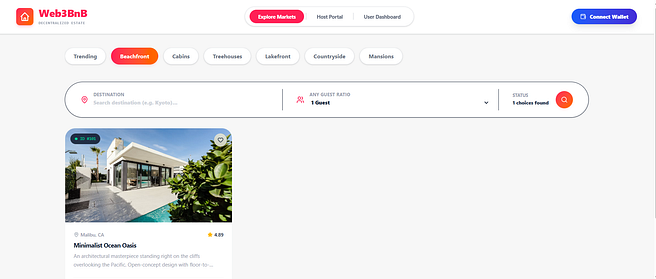
How to Build an Airbnb Clone Powered by Blockchain in 2026
Airbnb pulled in over $11B in revenue last year while taking 15–20% off nearly every booking and holding all the platform power hosts can be delisted, guests can be locked out, and disputes get resolved by a centralized support team with zero transparency.
I’ve been mapping what a real Web3 Airbnb rebuild looks like, and the architecture is more achievable than most builders think.
In this article, I’ll cover:
→ What a Web3 Airbnb platform actually is and why airbnb blockchain models are gaining traction
→ A technical breakdown of how to architect an Airbnb clone with smart contract escrow
→ A step-by-step build guide from MVP to production
→ Monetization strategies that don’t rely on a centralized take-rate
→ Marketing and distribution for a new web3 airbnb platform in 2026
Let’s dig in →
Why Web3 Airbnb Is a Real Opportunity Right Now
Press enter or click to view image in full size
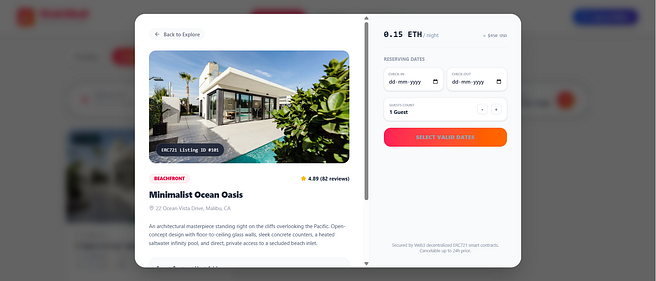
Why Web3 Airbnb Is a Real Opportunity Right Now
Funding → Proptech and travel-tech are seeing renewed VC interest as builders look for vertical applications of blockchain beyond pure DeFi. Airbnb development with a Web3 layer is one of the clearer product-market fits in the space.
User Base → Airbnb itself has 5M+ active hosts globally. Even capturing a sliver of hosts frustrated with fee structures and account suspensions is a meaningful addressable market for a new airbnb clone.
Engagement → Booking platforms have naturally high repeat usage — once a host or guest trusts a platform’s payment and dispute system, switching cost favors retention.
Earnings → Traditional Airbnb clones monetize at 10–15% take rate. A web3 airbnb model can undercut that significantly using smart contract automation, while still generating strong margins at scale.
Market Impact → Short-term rental regulation is tightening in major cities, which is pushing some hosts toward platforms offering more transparency and direct payout control — exactly what airbnb blockchain architecture provides.
Blockchain → EVM L2s (Base, Polygon, Arbitrum) are the practical choice for a web3 airbnb build — low gas costs make per-booking smart contract interactions economically viable, something that wasn’t true on mainnet Ethereum a few years ago.
Growth → Search interest in “airbnb clone,” “airbnb clone github,” and “open source airbnb clone” stays consistently high among developers — this is one of the most-cloned SaaS categories in existence, which means there’s a built-in audience actively looking for guidance.
Ready to delve deeper? Let’s begin!
What Is a Web3 Airbnb Platform?
Press enter or click to view image in full size
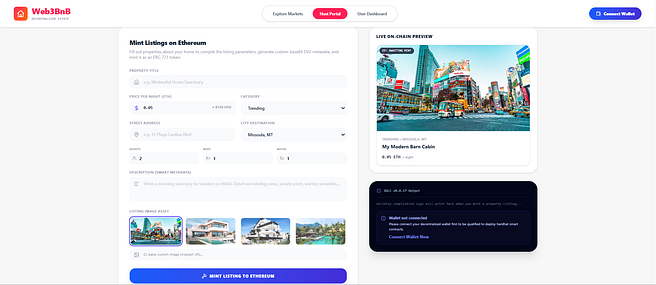
What Is a Web3 Airbnb Platform?
A Web3 Airbnb platform is a short-term rental marketplace that uses blockchain infrastructure for the parts of the booking process that are usually centralized — payments, reputation, and dispute resolution. Think of it as an Airbnb clone where the trust layer runs on smart contracts instead of a company’s internal database.
Why build it on blockchain specifically? Three core reasons:
Escrow without a middleman. A smart contract holds guest funds until check-in is confirmed (or a dispute window closes), then automatically releases payment to the host. No payment processor sitting in the middle taking days to settle and a cut to do it.
Portable reputation. Host and guest reviews stored on-chain (or via verifiable credentials) can’t be deleted by a platform and travel with the user if they ever move to a different platform — solving the lock-in problem that frustrates long-time Airbnb hosts.
Lower cross-border friction. Stablecoin payments mean a host in Bali getting booked by a guest in Germany doesn’t lose 3–5% to currency conversion and card processing fees.
Benefits breakdown:
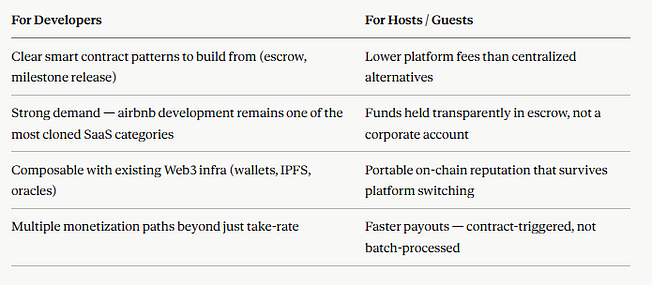
Why Build This as a Web3 Airbnb Instead of a Traditional Clone
Press enter or click to view image in full size
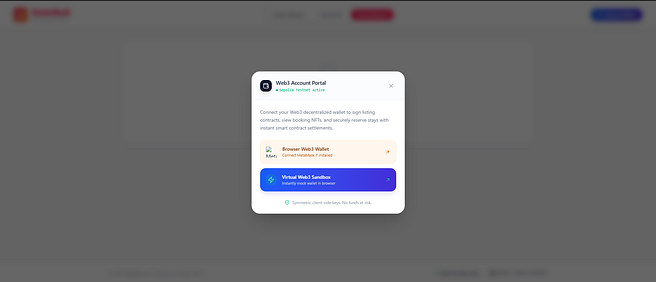
Why Build This as a Web3 Airbnb Instead of a Traditional Clone
Trust is enforced by code, not policy. Centralized platforms can freeze funds or delist accounts unilaterally. A well-designed web3 airbnb smart contract enforces the rules the same way every time that predictability is a selling point hosts actually care about.
Lower structural costs mean a more competitive take rate. Without a large trust-and-safety and payments-processing org to fund, a lean web3 airbnb team can operate profitably at a lower fee than legacy platforms.
Global payments without the banking friction. Hosts in regions with weak banking infrastructure or currency instability benefit enormously from stablecoin payouts, as this is an underserved segment most Airbnb clones ignore entirely.
Composability with the broader Web3 stack. On-chain reputation can plug into other Web3 products later — DAOs, lending protocols using booking history as a credit signal, loyalty programs across multiple dApps.
A genuinely differentiated story for fundraising and marketing. “Another Airbnb clone” is a hard pitch. “Airbnb blockchain platform with zero-custody escrow” gives you a sharper narrative for both investors and early hosts.
Building Your Web3 Airbnb Stack
Press enter or click to view image in full size
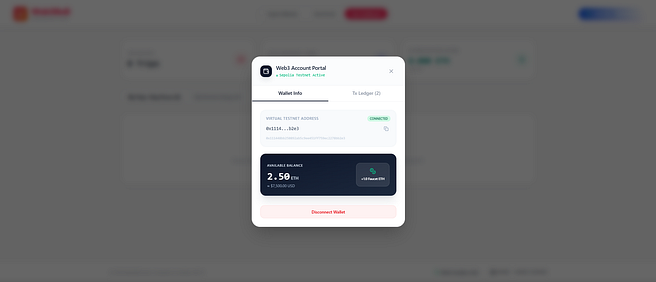
Building Your Web3 Airbnb Stack
I’ll break this down the way I’d actually architect it — frontend, backend, database, smart contract layer, and wallet integration.
4a. Frontend
Stack: Next.js + Tailwind + wagmi/viem for wallet connection
This is your standard Airbnb clone react-style build, with a Web3 layer added on top.
Listing search and filtering (location, dates, price, amenities) — same UX patterns as any modern Airbnb clone website
Booking calendar component with availability sync
Wallet connect button (RainbowKit or ConnectKit work well here)
Booking confirmation flow that shows escrow status in plain language — most users have no idea what “smart contract escrow” means, so translate it: “Your payment is held securely until check-in”
Host dashboard showing listing performance, payout history, and on-chain reputation score
4b. Backend
Stack: Node.js (NestJS or Express) or Go, with a job queue for off-chain/on-chain sync
The backend handles everything that doesn’t need to live on-chain — search indexing, image storage references, messaging, notifications.
Listings API (CRUD, search, availability calendar)
Booking orchestration service — initiates the smart contract call, listens for confirmation events, updates booking status
Messaging service between host and guest (off-chain, just stored in your database) Event listener service that watches the blockchain for contract events (booking confirmed, funds released, dispute opened) and syncs them to your database for fast querying
4c. Database
Stack: PostgreSQL + Redis
→ listings — id, host_id, location, price, amenities, availability_calendar
→ bookings — id, listing_id, guest_id, contract_address, status, check_in, check_out, escrow_tx_hash
→ users — id, wallet_address, reputation_score, kyc_status
→ reviews — id, booking_id, reviewer_id, rating, content, on_chain_hash
→ disputes — id, booking_id, status, resolution, resolved_at
Redis handles session caching and search result caching as booking platforms get hammered with read traffic on search, so cache aggressively.
4d. Smart Contract Layer
Stack: Solidity on an EVM L2 (Base or Polygon recommended for gas cost reasons)
This is the core differentiator of a true web3 airbnb build versus a regular Airbnb clone.
Escrow contract: Guest deposits funds on booking confirmation → funds locked until check-in date passes (or a dispute is raised) → automatic release to host wallet
Reputation contract: Lightweight on-chain record of completed bookings per address — can be a simple counter plus a hash pointer to off-chain review content stored on IPFS
Dispute module: Time-locked arbitration window — either a designated multisig (early stage) or a decentralized arbitration protocol (later stage) resolves disputes and triggers fund release accordingly
Cancellation logic: Encode your refund policy directly into the contract — partial refund tiers based on cancellation timing
Get this audited before mainnet deployment. This is the layer handling real user funds — do not cut corners here.
4e. Wallet Integration
Stack: wagmi + viem, with WalletConnect for mobile
Support MetaMask, Coinbase Wallet, and WalletConnect at minimum — covers the vast majority of your early Web3-native user base
Consider account abstraction (ERC-4337) for non-crypto-native users — let them sign up with email/social and get a smart wallet under the hood, removing the seed-phrase barrier that kills mainstream adoption
Gas sponsorship for first-time bookings is worth considering — a guest abandoning a booking because they don’t have ETH for gas is a conversion killer
4f. Key Summary
Press enter or click to view image in full size
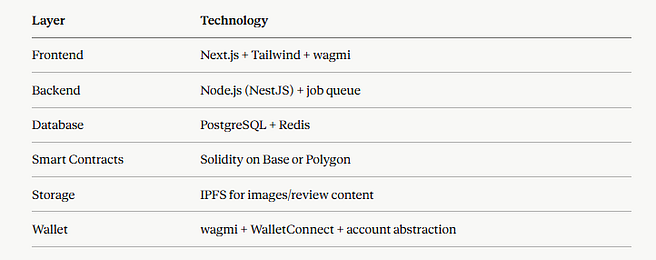
This confirms something for me: the hard part of a web3 airbnb build isn’t the blockchain piece, it’s translating Web3 mechanics into UX that doesn’t scare off non-crypto-native hosts and guests.
Get that translation right and the rest is standard, well-understood engineering.
Step-by-Step Build Guide
Step 1 — Scope your MVP tightly
Pick one city or region to launch in, not a global platform from day one
Pick one chain — Base or Polygon are both solid for low gas costs
Decide your escrow model and cancellation policy before writing contract code — this is hard to change later
Step 2 — Build the listings and booking core
Press enter or click to view image in full size
Listing creation flow (host side)
Search and availability calendar (guest side)
This part is identical to any standard Airbnb clone — don’t over-engineer it early
Step 3 — Write and test your smart contracts
Start on testnet (Base Sepolia or Polygon Amoy)
Write the escrow contract first — get the deposit/release/refund logic rock solid
Add the reputation and dispute modules once escrow is proven
Get an audit before any mainnet deployment, even for an MVP
Step 4 — Wire up wallet integration
Implement wagmi/viem wallet connect
Add account abstraction if you want to onboard non-crypto users smoothly
Test the full booking flow end-to-end with real testnet transactions
Step 5 — Add the off-chain sync layer
Event listener service watching contract events
Sync booking status, payout confirmations, and dispute events to your database
Build the host and guest dashboards on top of this synced data
Step 6 — Launch in one market, then iterate
Onboard a small batch of hosts manually — talk to every one of them
Watch the booking flow for friction points, especially around wallet usage
Expand city by city once the core loop is proven
You now have the blueprint for a working Web3 Airbnb platform. Most of the engineering challenge here is well-trodden — the differentiation comes from getting the trust layer right.
Monetization Strategies
Booking Fee (Lower Than Centralized Take Rate)
Charge a smaller percentage per booking than traditional platforms — the lower operating overhead of a web3 airbnb model (no large payments-processing team) makes this sustainable even at 5–8% versus the typical 15–20%.
2. Premium Host Tools
Offer advanced analytics, dynamic pricing tools, and priority placement as a subscription tier for hosts who want to optimize earnings.
3. Freemium Listing Model
Free basic listings, paid boosted visibility — similar to how many marketplace platforms monetize discovery without gating core functionality.
4. Token / Loyalty Integration
A platform token that rewards repeat bookings and reviews can drive retention, though this adds regulatory complexity — weigh carefully before going this route versus simply using stablecoins for payments without a native token.
Choosing the Right Model:
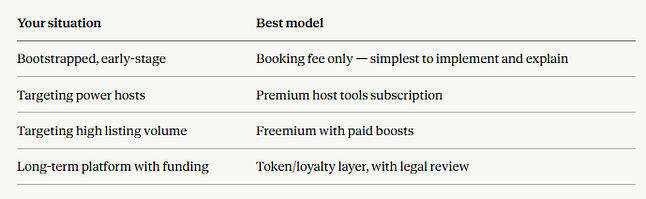
Marketing Strategies
Telegram → Build a host community channel early — hosts frustrated with centralized platforms are vocal and will share a genuinely better alternative.
Twitter/X → Post build-in-public updates on your airbnb development progress — the “open source airbnb clone” and Web3-builder audience on Twitter engages heavily with transparent build threads.
Discord → Run a dedicated server for early hosts and guests to give feedback directly — this is your highest-signal channel during the first 100 bookings.
Content Marketing → Target developer search terms like “airbnb clone github,” “full stack airbnb clone,” and “airbnb source code” with technical breakdowns — this audience either builds their own or becomes a lead for your white-label offering.
Partnerships → Partner with crypto-friendly destinations and co-living spaces already comfortable with Web3 payments — faster trust-building than cold outreach to traditional hosts.
Referral Programs → Token or fee-discount referral incentives for hosts who bring other hosts onto the platform — the strongest growth lever in any two-sided marketplace.
Want to Build a Web3 Airbnb Clone? Here’s How We Help.
Press enter or click to view image in full size
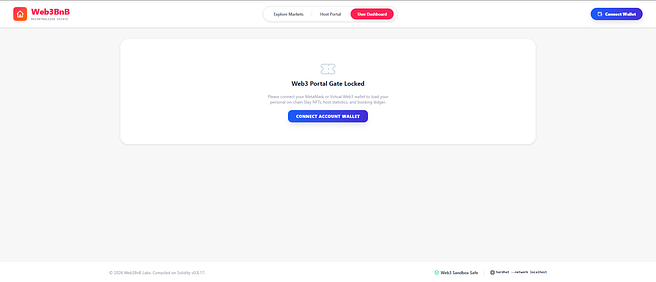
Want to Build a Web3 Airbnb Clone? Here’s How We Help.
I’ve mapped this exact architecture. If you want to skip the months of trial and error, here’s what we offer:
Pre-Built Solution — A modular Airbnb clone foundation with the booking core already built, ready to layer in smart contract escrow and wallet integration.
Faster Deployment — Launch your web3 airbnb MVP in weeks instead of architecting from zero, with smart contracts already tested on testnet.
Customization Options — White-label branding, your chain of choice, your fee structure, your token model (or no token at all) — fully yours.
9. Conclusion
Building a web3 airbnb platform in 2026 is genuinely achievable with the current state of L2 gas costs and wallet UX — the technical barriers that made this impractical a few years ago have largely fallen away.
The real challenge isn’t the blockchain layer, it’s earning trust from hosts and guests who’ve never touched a wallet before, and that takes patient onboarding, not just good contracts.
I’d be watching how account abstraction and gas sponsorship evolve over the next year — that’s the unlock that turns this from a crypto-native niche product into something a regular Airbnb host would actually switch to.
Disclaimer: This is based on what I’ve seen building in Web3. Nothing here is financial advice. Do your own research before deploying or investing.
— Akash, your web3 guy
Frequently Asked Questions
What is an Airbnb clone?
An Airbnb clone is a software platform that recreates the core functionality of Airbnb, including property listings, search and filtering, booking management, payments, and host-guest messaging. Developers build Airbnb clones for learning purposes, as white-label SaaS products, or as the foundation for niche marketplaces such as Web3 accommodation platforms, co-living networks, or vacation rental startups.
Is there an open-source Airbnb clone available on GitHub?
Yes. There are many open-source Airbnb clone projects available on GitHub, built using different technology stacks such as MERN (MongoDB, Express, React, Node.js), Next.js with Prisma, and Django. Most include features like property listings, booking calendars, and user authentication. However, they typically lack production-grade features such as advanced payment processing, fraud prevention, and scalable search systems.
How do you build an Airbnb clone in React?
Building an Airbnb clone in React usually involves creating reusable frontend components such as listing cards, search filters, booking calendars, and map views. State management tools like Redux or Zustand are commonly used, while the frontend connects to a backend API that manages listings and bookings. Popular backend options include Node.js and Express, along with databases such as PostgreSQL or MongoDB. Payments can be handled through Stripe or Web3 wallets depending on the platform's requirements.
What is a Web3 Airbnb platform?
A Web3 Airbnb platform uses blockchain technology to power short-term rental bookings. It may include smart contracts for escrow and automatic payouts, decentralized identity systems, token-based reputation mechanisms, and cryptocurrency payments. The goal is to reduce platform fees, increase transparency, and give hosts more control over their listings and earnings.
How much does full-stack Airbnb clone development cost?
The cost depends on the scope of the project. A basic MVP with listings, bookings, and payments generally costs between $15,000 and $40,000. Adding Web3 features such as smart contract escrow, wallet integration, and on-chain reputation systems can increase costs by another $10,000 to $30,000. Enterprise-level platforms with advanced administration tools, dispute resolution systems, and multi-currency support can exceed $100,000.
What is the best tech stack for an Airbnb clone website?
A modern Airbnb clone is often built using Next.js for the frontend, Node.js or Go for backend services, PostgreSQL for booking data, Redis for caching, and Elasticsearch or Algolia for search functionality. For Web3-based platforms, developers may add Solidity smart contracts, IPFS for decentralized storage, and wallet integration libraries such as wagmi and viem.
Can I find Airbnb source code for reference?
Airbnb's actual production source code is not publicly available. However, many educational Airbnb clone projects can be found on GitHub that replicate key platform features. These projects are useful for learning about booking workflows, database structures, and application architecture, but they should not be considered production-ready solutions.
How can blockchain improve the Airbnb business model?
Blockchain can improve the traditional Airbnb model by using smart contract escrow for secure payments, creating portable and tamper-proof reputation systems, and reducing cross-border transaction costs through cryptocurrency or stablecoin payments. These improvements can lower fees and increase transparency for both hosts and guests.
What should an Airbnb project report include?
A comprehensive Airbnb project report should cover system architecture, database design, API documentation, security considerations, deployment strategies, and user workflows. If blockchain technology is included, the report should also explain the smart contract architecture, gas optimization strategies, and any security audits performed.
Is building a Web3 Airbnb platform legally complicated?
Yes. Short-term rental regulations vary significantly across cities and countries. Adding blockchain-based payments introduces additional compliance requirements related to KYC (Know Your Customer) and AML (Anti-Money Laundering) regulations. Anyone launching a Web3 Airbnb platform should consult legal professionals familiar with both property technology and cryptocurrency regulations.
What programming languages are commonly used in Airbnb clone projects?
Most Airbnb clone projects use JavaScript or TypeScript across the stack, with React or Next.js on the frontend and Node.js on the backend. Some projects use Python frameworks such as Django or FastAPI. Web3 implementations often add Solidity for Ethereum-compatible blockchains or Rust for Solana-based applications.
Should I build my Airbnb clone using a no-code platform or custom code?
No-code platforms can be useful for validating ideas quickly, but they often struggle with complex booking workflows, advanced payment systems, and blockchain integrations. For startups planning to scale or incorporate Web3 features, custom development is usually the more flexible and reliable option.
Need a custom Web3 platform for your project?
We design, build and deploy custom audited staking portals, claim utilities, prediction markets, and crypto casinos tailored to your branding. Fully operational in 2–4 weeks.


