
How to Build an On-Chain Lottery Platform Like Megapot.io And Monetize It
How to Build an On-Chain Lottery Platform Like Megapot.io
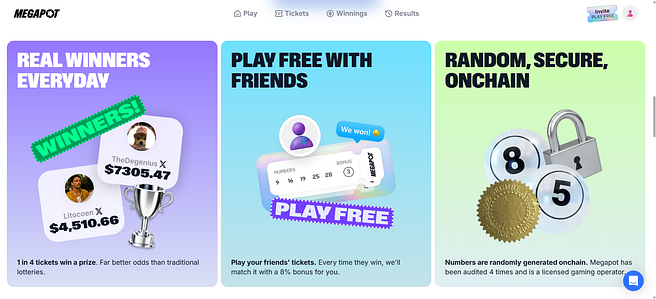
Most people look at Megapot and see a crypto lottery.
But i look at it and see something different: a daily recurring revenue machine with three distinct monetization layers, a self-reinforcing flywheel, and a protocol architecture that’s genuinely hard to replicate once it reaches escape velocity.
Press enter or click to view image in full size
This breakdown is for founders, builders, and protocol designers who want to understand how this actually works, not the surface level, but the mechanics underneath.
We’ll cover:
What an on-chain lottery platform actually is (and why it’s not what you think)
The full technical architecture — contracts, randomness, prize logic
How to build one, component by component
Why you’d build it, and the three monetization models that make it viable
Let’s get into it.
What Is an On-Chain Lottery Platform?
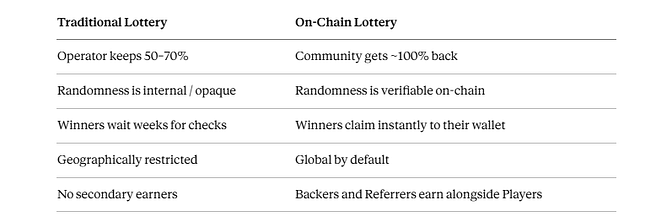
A traditional lottery is a government-operated revenue extraction machine.
They keep 50–70% of every dollar you spend. The rest prizes, marketing, operations gets distributed however the operator decides.
You have no visibility into the math and you just trust that it’s fair.
An on-chain lottery flips this model completely.
Here’s what changes:
Press enter or click to view image in full size
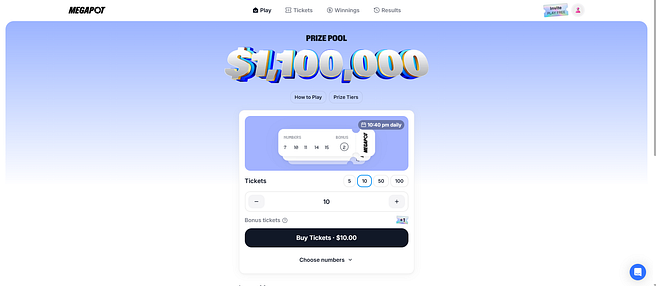
Megapot is the clearest live example.
$1 per ticket.
Daily drawings.
$1M+ prize pools.
Since July 2024 they’ve run over $200M in drawings and created 19 jackpot winners.
Press enter or click to view image in full size
The key insight: it’s not just a lottery. It’s a three-sided marketplace with Players, Backers (liquidity providers), and Referrers , all earning from the same system simultaneously.
That’s what makes it worth building.
This is not a “big brand only” play. On-chain lotteries work even at a hyper-local level.
If people in Kerala,India buy offline lottery tickets every single day, imagine the pull of:
Transparent draws
Instant payouts
No middlemen
24/7 global access
Most chains are still wide open for this product:
Solana
TON
EVM (beyond BSC)
The opportunity is not “who builds it best.” It’s who builds it first on the right chain + niche.
If you’re thinking of cloning this for a specific region, community, or chain — keep reading.
If you want to move fast and own this category before it gets crowded:
How Megapot.io Works?
Before you build, you need to understand the full loop.
The Three Participants
Press enter or click to view image in full size
Players
Buy $1 USDC tickets.
Pick 5 numbers (1–30) + 1 bonusball.
Win across 10 prize tiers.
Backers
Deposit USDC into the prize pool.
Act as “the house.”
Earn ~20% of ticket revenue over time as their expected return.
Take on variance risk in exchange for yield.
Referrers
Share a unique link.
Earn 8% of ticket purchases and 8% of winnings from their referrals.
Plus 2% from second-level referrals.
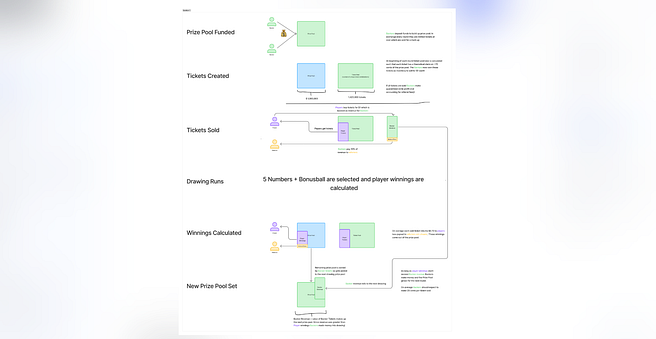
The Money Flow
Every $1 ticket breaks down like this:
70% → Prize payouts across all 10 tiers
20% → Backers (as expected return on capital provided)
10% → Referrers (purchase fees + win share)
This means 0% leaves the ecosystem. Every dollar either wins prizes, pays yield, or rewards growth.
That’s what “community-run” actually means structurally.
Prize Tier Structure
There are 10 winning combinations:
Press enter or click to view image in full size
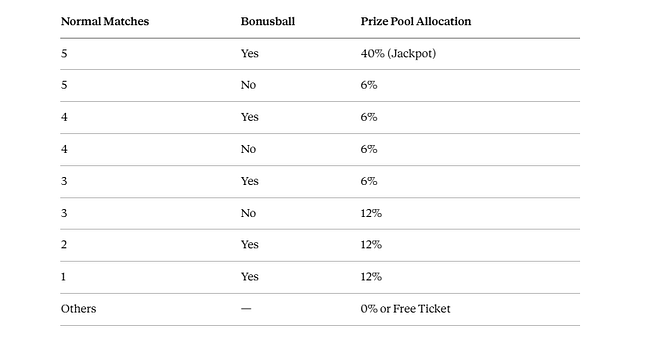
1 in 4 tickets wins something. That’s a materially better odds profile than most state-run lotteries.
The Dynamic Bonusball Range
Here’s the mechanism most people miss.
The bonusball range isn’t fixed. It adjusts based on pool size:
Larger pool → Wider bonusball range → Longer jackpot odds
Smaller pool → Narrower range → Shorter jackpot odds
This keeps the system actuarially solvent. If jackpot odds were fixed and pools grew large, backers would face asymmetric loss risk and rationally exit.
The dynamic range keeps the backer edge constant regardless of pool size.
It’s elegant game theory baked into the contract logic.
How to Actually Build A Platform like Megapot.io?
This is where most builders stop reading generalist content and start looking for engineers. Don’t stop here.
The architecture is more approachable than it looks.
Stack Overview
Base (L2 Ethereum) ← Where you deploy USDC (ERC-20)
Payment token ERC-721 (NFT Tickets) ← Each ticket is an NFT Pyth Network Entropy
Verifiable randomness Smart Contracts (Solidity) ← Core protocol logic
Dune Analytics ← On-chain data dashboards
Core Smart Contracts
You need roughly five primary contracts:
Jackpot Contract
The central state machine. Handles:
Drawing lifecycle (open → closed → settled)
Ticket minting and number storage
Prize tier calculation post-draw
Winner payouts
Key events to emit:
TicketPurchased(address buyer, uint256 ticketId, uint8[5] normals, uint8 bonusball)WinnersCalculated(uint8[5] winningNormals, uint8 winningBonusball, uint256[10] uniqueResults)PrizeClaimed(address winner, uint256 amount)
2. Prize Pool / Backer Contract
Handles LP positions:
deposit(uint256 amount)→ mints sharesinitiateWithdrawal()→ queues withdrawal for next settlementfinalizeWithdrawal()→ releases USDC post-settlementShare-based accounting (like an ERC-4626 vault)
The three-phase withdrawal (Initiate → Wait for drawing to complete → Finalize) is critical. It prevents a backer from front-running a bad draw by exiting just before settlement.
3. Referral Registry Contract
Tracks the referral graph:
registerReferral(address referrer, address referee)calculateFees(address referrer, uint256 saleAmount)→ returns 8% + 2% second-orderclaimFees(address referrer)→ instant withdrawal anytime
4. Randomness Consumer Contract
Interfaces with Pyth Entropy:
Requests randomness once the drawing window closes
Anyone can trigger this call — it’s permissionless
Combines Pyth’s returned random number with an on-chain entropy source
Seeds the number selection function
This two-party randomness model (Pyth + on-chain) is what makes it provably fair.
No single party including the protocol team can predict or manipulate the seed.
5. Ticket NFT Contract (ERC-721)
Each ticket is a minted NFT:
Stores the number selections on-chain
Allows claiming via
claimPrize(uint256 tokenId)Transferable (secondary markets become possible)
The Drawing Settlement Flow
Drawing window opens
Players buy tickets (numbers stored on-chain)
Window closes at set timestamp
Anyone calls requestRandomness() → Pyth entropy request
Pyth returns random bytes on-chain
Contract combines Pyth bytes + block hash → seed
Seed → 5 normal numbers + 1 bonusball selected
WinnersCalculated event emitted
Backers’ pool rebalances
Players claim prizes at their convenience
Total settlement: automated, trustless, instant.
Why megapot choose Pyth?
Pyth Network’s entropy protocol uses a commit-reveal scheme:
Before the draw, Pyth commits to a hash of their random value
After ticket sales close, they reveal the preimage
The contract verifies the hash matches and uses the value
This means Pyth cannot retroactively change the random number, the commitment is already on-chain. Combined with block hash entropy from the chain itself, neither Pyth nor the contract deployer can know what seed will be generated.
This is the gold standard for on-chain RNG. The Megapot contracts were audited by Zellic, Code4rena, and RiskCherry, three separate firms before launch.
How Megapot Payout Calculation Logic Works?
Press enter or click to view image in full size
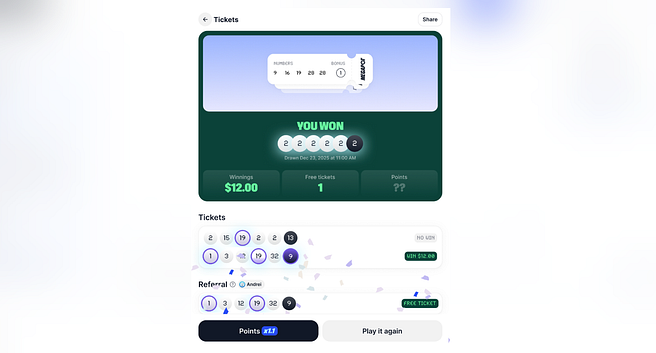
The payout system has two layers:
Guaranteed Minimums — Each winning tier has a floor payout per ticket. This is calculated before premium distribution.
Premium Pool — After guarantees are set aside, what remains becomes the premium. Each tier gets a percentage allocation of this pool.
Final payout = Guaranteed minimum + Share of premium for that tier
For duplicate number combinations (multiple tickets picking the same winning numbers), the premium is split proportionally.
This incentivizes unique number selection, a subtle game theory nudge built into the payout math.
Enjoying this breakdown? I share insights like this regularly — deep dives, operator lessons, and things most crypto blogs won’t tell you. Subscribe for free to stay ahead and support the work.
How to Build Megapot.io?
Phase 1: Core Protocol (Weeks 1–8)
Week 1–2: Architecture Design
Define token (USDC on Base is the obvious choice — stablecoin, L2 fees are negligible)
Define drawing frequency (daily is optimal — creates habit loops)
Define prize tier structure (10 tiers gives enough surface area for meaningful wins at all levels)
Week 3–4: Core Contracts
Jackpot contract with drawing lifecycle
Basic ticket minting (ERC-721)
Pyth entropy integration (their docs are solid, integration is ~200 lines of Solidity)
Week 5–6: Backer Pool
Share-based vault logic (reference ERC-4626 standard)
Three-phase withdrawal mechanism
Fee distribution math
Week 7–8: Referral System
Graph registration (referrer → referee mapping)
Two-level fee calculation
Claimable fee tracking
Tools you’ll use:
Hardhat or Foundry (Foundry preferred for testing)
OpenZeppelin contracts library
Pyth Network SDK
Base testnet for staging
Phase 2: Audits and Security (Weeks 9–12)
Do not skip this phase.
A lottery contract holds user funds, manages prize pools, and handles daily financial settlements. You need at least two independent audits before mainnet.
Minimum audit checklist:
Re-entrancy attacks on prize claims
Share manipulation in the backer vault
Randomness manipulation vectors
Fee calculation edge cases
Withdrawal griefing attacks
Get an RNG certificate separately if you plan to operate as a licensed gaming platform. This matters for regulatory compliance in certain jurisdictions.
Phase 3: Application Layer (Weeks 10–16, parallel)
The smart contract is the protocol. You also need the app.
Frontend requirements:
Ticket purchase flow (number picker + quick pick)
Live drawing countdown
Results display (winning numbers + tier breakdown)
My Tickets dashboard (past tickets, match results, claim buttons)
Backer position management
Referral dashboard (link generation, earnings tracking)
Backend requirements:
Indexer (Goldsky, The Graph, or Envio) — listens to contract events and builds queryable state
Dune dashboard for public transparency (Megapot publishes all their analytics publicly — this builds trust)
Notification system (email / push for drawing results)
Phase 4: Launch and Growth
Launch with:
A funded backer pool (you or investors seed initial liquidity)
A referral program active from day one
Public Dune dashboard (transparency is your trust signal)
Clear KYC/compliance framework if you’re running the application layer as a licensed operator
How to Earn Money by building Megapot.io clone?
This is the part most technical breakdowns skip. Let’s fix that.
Revenue Stream 1: Protocol Fee
As the protocol deployer, you can take a small cut of each drawing — typically 1–3% of ticket revenue — routed to a treasury address.
At 10,000 tickets/day at $1 each:
Daily revenue: $100–$300
Annual revenue: $36,500–$109,500 at current Megapot-scale volume
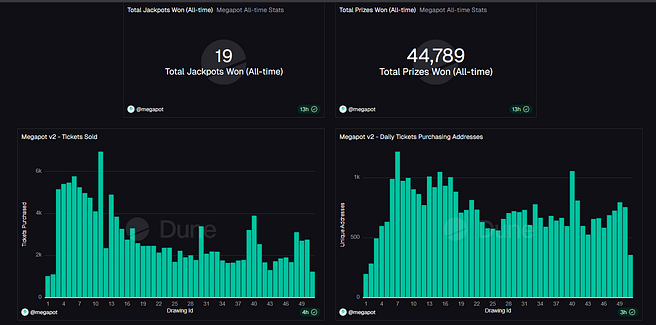
Megapot’s Dune dashboard shows 2,000–6,000 tickets per drawing currently. That’s a real baseline to model against.
Revenue Stream 2: Backer Position
Press enter or click to view image in full size
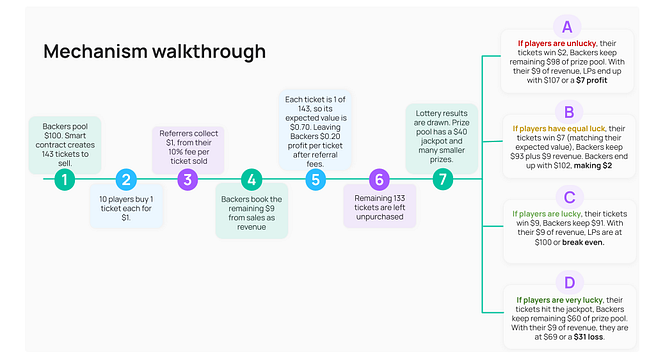
Deploy with treasury funds as a founding backer. The expected return per dollar deployed is ~20% of ticket revenue over time.
If you seed $100,000 and the pool does $10,000/day in tickets:
Backers collectively earn ~$2,000/day (20% of sales)
Your share = proportional to your ownership of the pool
This is yield on dollars, denominated in dollars, with variance. It’s not guaranteed by large jackpot hits reduce the pool but over hundreds of drawings, the math trends positive.
Revenue Stream 3: VIP Referral Partnerships
Press enter or click to view image in full size
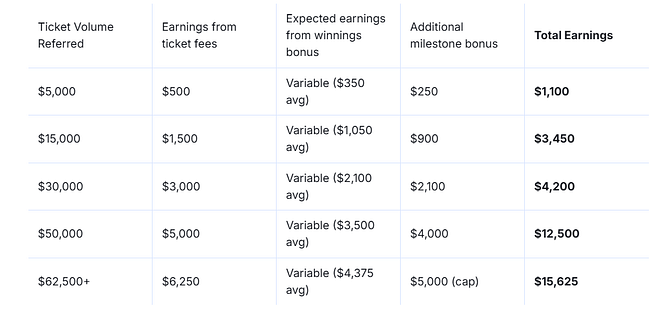
Structure a VIP tier for high-volume referrers (creators, communities, newsletters):
10% purchase fee on referral ticket sales
10% win share on referral prizes
Milestone bonuses for volume tiers
A referrer driving $50,000/month in ticket sales earns ~$5,000/month in purchase fees alone, plus expected win share. That’s a $60,000/year affiliate partner incentive which is powerful enough to attract serious distribution partners.
The protocol captures value through the base fee while referrers handle growth. It’s a capital-light customer acquisition model.
The Funding Angle
Press enter or click to view image in full size
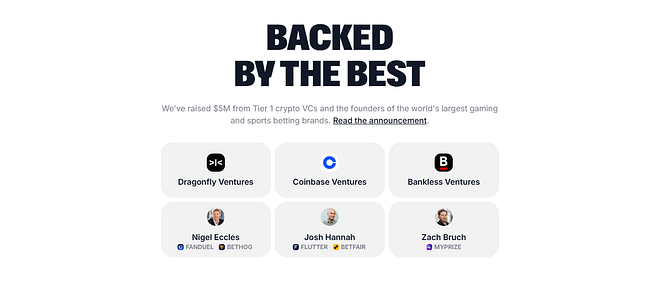
On-chain lottery platforms are fundable. Megapot raised a $5M pre-seed from Dragonfly, Coinbase Ventures, Bankless Ventures, and founders of FanDuel and Betfair.
The thesis investors are buying:
Daily active users with real economic stakes — not just speculators
Recurring revenue — ticket sales happen every day regardless of market conditions
Onboarding primitive — lottery is the most universally understood financial game globally
Protocol defensibility — once you have liquidity, it’s hard to dislodge
If you’re building this, position it as infrastructure for consumer crypto adoption, not a gambling product. The narrative matters for fundraising.
Key Mental Models You shoud think before building
Think like a market maker, not a lottery operator.
Your job is to keep the three-sided market in balance as Backers need edge.
Players need odds worth playing.
Referrers need commissions worth promoting.
Optimize for the system, not any single participant.
The dynamic bonusball range is your actuarial lever.
Use it. Don’t fix the odds.
Let the contract adjust them based on pool size so backers are always protected and the system stays solvent.
Transparency is your moat.
Every drawing verifiable.
Every payout public.
Every backer position auditable. Publish it all.
Traditional lotteries can’t compete on this axis, as they’re structurally opaque but you’re not.
Withdrawal mechanics protect the pool.
The three-phase withdrawal (initiate → wait for settlement → finalize) isn’t bureaucracy.
It’s game theory. Without it, backers would rationally exit before bad draws and destroy the system. The mechanism aligns incentives.
Key Takeaways
On-chain lotteries return ~100% of revenue to the community — prizes (70%), backers (20%), referrers (10%) — vs. traditional lotteries keeping 50–70%
The core stack: Solidity contracts on Base L2, USDC, ERC-721 tickets, Pyth Network entropy for provably fair randomness
Five core contracts: Jackpot, Prize Pool/Backer Vault, Referral Registry, Randomness Consumer, Ticket NFT
Three revenue streams for the builder: Protocol fee (1–3%), founding backer yield (~20% of ticket sales), VIP referral partnerships
The dynamic bonusball range is how the system stays actuarially solvent as the prize pool grows
Two mandatory audits minimum before mainnet — this contract holds user funds daily
Fundraisable thesis: daily recurring revenue, consumer onboarding primitive, protocol defensibility — Megapot raised $5M pre-seed on this exact narrative
We help builders design, build, and launch on-chain lottery platforms within 30 days on:
Solana
TON
Any EVM-compatible chain
Including:
Smart contracts
Frontend
Wallet integration
Fair draw logic
Monetization setup
If you want to move fast and own this category before it gets crowded:
Frequently Asked Questions
Do I need a gambling license to deploy an on-chain lottery protocol
The protocol itself is permissionless code on a public blockchain, it isn’t a licensed entity. However, if you build and operate an application layer (a website, app, or interface) that facilitates ticket purchases for users, you’re operating as a gaming operator and licensing requirements apply by jurisdiction. Megapot explicitly distinguishes between “the protocol” (permissionless) and “the application” (licensed gaming operator). Structure your legal entity accordingly before launch.
What’s the minimum viable prize pool to make the lottery attractive to players?
At minimum, you need enough to credibly offer a meaningful jackpot. Megapot launched with seed backers funding over $1M in initial pool capital. As a rule of thumb, your jackpot needs to be at least 50–100x the ticket price to trigger dopamine-level aspiration in players. At $1/ticket, $100K minimum is a workable starting floor — $1M is aspirational and fundable from day one if you raise.
How do I prevent the prize pool from being wiped by a large jackpot hit?
Two mechanisms: (1) The dynamic bonusball range widens as the pool grows, reducing jackpot odds and protecting against outsized payouts relative to pool size. (2) The guaranteed minimum / premium split means even jackpot payouts are bounded by pool size. Run simulations before launch — Megapot built public profit simulators so backers can model their own risk. Do the same.
Why Base (L2) instead of Ethereum mainnet or Solana?
Base gives you Ethereum security with transaction costs low enough for $1 ticket purchases to be economically viable. On mainnet, gas alone could cost more than the ticket. Solana is fast and cheap but its smart contract ecosystem (Anchor/Rust) is a steeper build and has less DeFi composability. Base also has Coinbase distribution — meaningful for consumer onboarding, which is exactly what a lottery product targets.
How long does a full build take before mainnet?
Realistically: 4–6 months for a solo founding team, 2–3 months with a dedicated 3–4 person engineering team. The critical path is: core contracts (6–8 weeks) → audits (4–6 weeks, runs parallel with app build) → app layer (8–12 weeks). Don’t rush the audit phase. The contracts handle live user funds from day one.
What makes Pyth Network better than Chainlink VRF for lottery randomness?
Both are solid options. Pyth’s entropy uses a commit-reveal scheme where randomness is committed to before ticket sales close and revealed after — making it impossible for Pyth itself to manipulate results based on ticket distribution. The two-party randomness model (Pyth + on-chain block hash) means no single entity controls the seed. Chainlink VRF is also audited and battle-tested; the choice often comes down to chain compatibility, latency requirements, and cost per request at your expected drawing frequency.
Need a custom Web3 platform for your project?
We design, build and deploy custom audited staking portals, claim utilities, prediction markets, and crypto casinos tailored to your branding. Fully operational in 2–4 weeks.


