
How to Build a Free Cryptocurrency Faucet Platform in 2026
The original Bitcoin faucet gave away 5 BTC per claim in 2010. Today, the same infrastructure idea powers developer tooling for $500B+ in EVM ecosystem value and most builders have no idea how to build one that doesn’t get drained in 48 hours.
I’ve shipped wallets, exchanges, launchpads, and grant tools. The crypto faucet is one of the most underestimated infrastructure plays in Web3 right now — simple on the surface, brutally hard to operate well, and wide open for anyone who builds the right architecture from day one.
In this article, I’ll cover:
→ What a crypto faucet actually is and why faucet meaning matters in 2025
→ The technical breakdown of a production faucet stack
→ A step-by-step build guide from MVP to hardened system
→ Monetization models — from free crypto drips to full faucet platforms
→ Marketing and distribution for crypto faucet sites and apps
Let’s dig in →
1. Trend Snapshot — Why Crypto Faucets Are Infrastructure Now
Funding → Developer tooling is the fastest-growing vertical in Web3 VC. Faucet infrastructure is a core primitive — Google Cloud, Alchemy, and Infura all run faucets as lead-gen and ecosystem support.
User Base → Cointiply, one of the most-visited free crypto platforms, has processed hundreds of millions of micro-claims. FreeBitcoin has had over 40M registered users. The demand for crypto gift and reward mechanics is not niche.
Engagement → Auto faucet sites and crypto games faucet mechanics drive some of the highest daily active user rates in Web3 apps — because small, frequent rewards create powerful habit loops.
Earnings → A mid-size faucet platform monetizing via ads and affiliate deals can generate $5K–$50K/month depending on traffic quality and chain. The best faucet operators treat it as a media business, not just a utility.
Market Impact → Every major chain launch includes a testnet faucet. Sepolia, BNB testnet, Base, and Solana devnet all depend on faucet infrastructure to onboard developers. This is a B2B2C play as much as a consumer one.
Blockchain → EVM chains (Ethereum, Base, BNB Smart Chain, Polygon) dominate. Sol faucet demand is growing fast given near-zero Solana transaction fees — making it viable to run high-frequency auto faucet systems economically.
Growth → Search volume for “crypto faucet free”, “testnet faucet free”, “free ETH faucet”, and “best crypto faucet” has grown YoY as developer activity accelerates across L2s and alt-L1s.
Ready to delve deeper? Let’s begin.
2. What Is a Crypto Faucet?
A crypto faucet is a web application that distributes small amounts of cryptocurrency to users who prove they’re human. The faucet meaning is exactly what it sounds like — a slow drip, not a flood. You send a wallet address, pass a human check, and receive a small amount of free crypto.
Why is this useful? Two completely different reasons depending on the context:
For developers: Testnet tokens have no real value but are required to pay gas fees when testing smart contracts. A testnet faucet is how every Solidity or Rust developer gets started. Without it, developer onboarding breaks. This is why companies like Alchemy, QuickNode, and Google Cloud run faucets — it’s top-of-funnel for their API products.
For consumers: Mainnet faucets — including crypto faucet apps like Cointiply, FreeBitcoin, and FaucetPay — distribute tiny real-value crypto gifts as a marketing tool or engagement mechanic. Revenue comes from ads shown to users during claim sessions.
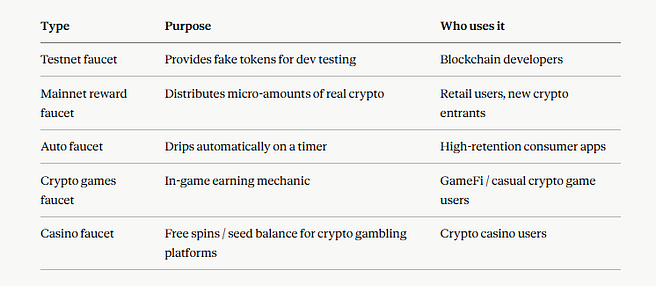
Faucet type breakdown:
Press enter or click to view image in full size
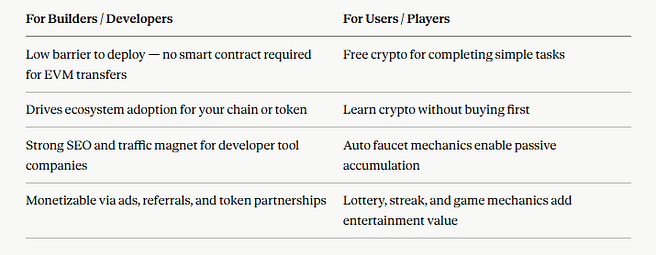
Benefits breakdown:
Press enter or click to view image in full size
3. Why EVM Chains Dominate Faucet Infrastructure
Four reasons I keep recommending EVM for faucet builds:
→ Wallet compatibility is universal. Every user already has MetaMask. Every developer already knows how to sign transactions. You skip the onboarding problem entirely.
→ Transaction fees are predictable on L2s. Base, Polygon, and BNB Smart Chain give you sub-cent transactions, which means you can run a high-frequency auto faucet without burning through treasury on gas.
→ Open-source tooling is mature. ethers.js, viem, wagmi — the full Web3 frontend stack is battle-tested. You’re not reinventing the wheel.
→ The sol faucet gap is real. Solana’s near-zero fees make it equally attractive, and developer tooling there is growing fast. If you want to build a crypto faucet app with a first-mover advantage, a Solana-native faucet builder tool is underserved.
→ Multi-chain is the play. The best faucet operators abstract chain selection — one interface, multiple networks. This expands your TAM dramatically.
4. Technical Deep Dive — Building Your freeFaucet Stack
I’m going to walk you through how a production faucet is actually architected. I’ll reference a pattern inspired by FreeFaucet, an open-source EVM faucet I’ve studied closely — a modular, defense-in-depth system built to survive serious bot pressure.
4a. The Modular Protection Architecture
The core insight of FreeFaucet is this: there is no single control that stops all abuse. Every faucet builder who ships a basic CAPTCHA-only system gets drained within days. The defense is in layers.
Here’s the module map:
Press enter or click to view image in full size
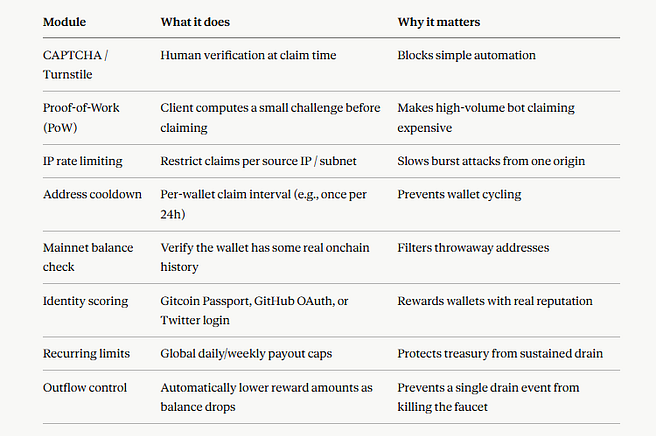
The PoW module deserves special attention. It’s not mining in the monetary sense — the client computes a small but nontrivial hash challenge, and the server verifies it cheaply. This makes it expensive to run a bot farm because compute cost rises with volume, while a legitimate user only solves it once. That asymmetry is the whole point.
Recommended protection tiers:
4b. Frontend
Stack: Next.js or SvelteKit + wagmi (wallet connect) + Cloudflare Turnstile widget
The frontend has one job: collect a wallet address and run the selected human verification challenge. Nothing else. Do not handle signing here. Do not expose any wallet keys.
Key components:
→ Wallet address input with ENS resolution
→ Turnstile widget (renders server-side challenge)
→ Optional PoW worker running in a WebWorker so it doesn’t block UI
→ Claim status polling (submit → pending → success/fail)
→ Network selector if you’re running multi-chain
→ Treasury balance display so users know the faucet is live
4c. Backend API
Stack: Node.js (Fastify) or Go → Redis → PostgreSQL → job queue (BullMQ or similar)
This is where all policy enforcement happens. The claim flow in strict order:
Parse and normalize wallet address
Validate Turnstile token server-side (Cloudflare Siteverify endpoint) — never trust the frontend widget alone
Check denylist (IP, address, identity)
Check rate limits (IP cooldown, address cooldown, identity cooldown, identity+address combined)
Persist claim record with all metadata
Push to payout queue
Return {status: “pending”, claimId, estimatedWait}
Critical rule: Steps 2–4 must complete before any database write. Validate first, log everything, enqueue last.
4d. Database Schema
Press enter or click to view image in full size
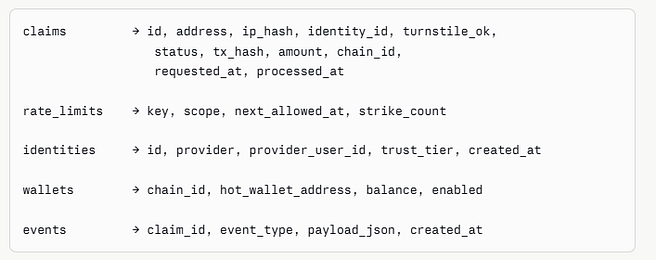
Store every request — including rejected ones. Your abuse detection is only as good as your logs.
4e. Payout Worker
Stack: Separate Node.js or Go process → viem / ethers.js → dedicated RPC endpoint
The worker is a completely separate process from the API. It:
→ Polls the payout queue
→ Reads the claim record
→ Signs and broadcasts the transfer from the hot wallet
→ Updates claim status and tx_hash
→ Handles RPC errors and retries with backoff
Golden rule: The web request thread never touches the private key. Signing lives in the worker and nowhere else.
4f. Key Summary — FreeFaucet-Inspired Stack
Press enter or click to view image in full size
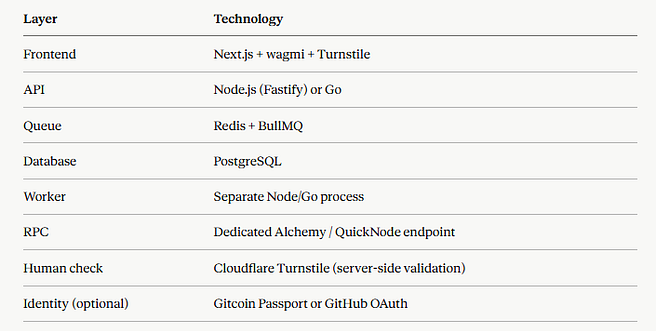
This confirms something for me: the engineering problem in faucets is not the blockchain part — it’s the abuse prevention part. Get the protection architecture right and everything else is relatively standard web development.
5. Step-by-Step Build Guide
Here’s the exact order I’d build this in if I were starting from scratch today.
Step 1 — Define your payout policy before writing a single line of code
Which chain? Start with one.
What token? Native gas token is easiest (no contract call needed).
How much per claim? Start conservatively — you can always increase.
What’s the cooldown? 24 hours per address is a common baseline.
What’s your treasury budget? Set a hard monthly ceiling and build the outflow module from day one.
Step 2 — Build the claim API with strict input validation
Accept: wallet address, Turnstile token, optional identity token
Reject: anything that fails address format validation, oversized payloads, missing tokens
Log: every attempt, even before validation passes
Step 3 — Add Turnstile to the frontend, validate it server-side
Embed the Turnstile widget on your claim form
On submission, send the token to your backend
Your backend calls Cloudflare Siteverify — if it fails, reject immediately
Do not process the claim before this step completes
Step 4 — Add rate limiting across four dimensions
By IP address
By wallet address
By identity (if using OAuth)
By identity + address combined (someone rotating wallets on the same account)
Use Redis TTL keys — fast, atomic, easy to tune
Step 5 — Add the payout worker with a dedicated hot wallet
Fund a separate hot wallet — never use your main treasury wallet
Keep the balance low and refill manually (reduces blast radius if keys are compromised)
Use a dedicated RPC endpoint — shared public nodes will throttle you fast
Return a claimId immediately from the API; let the client poll for status
Step 6 — Add abuse monitoring from day one
Flag burst timing (many claims from different wallets in a short window with similar IPs)
Flag address clustering (multiple claims landing in the same receiving wallet)
Flag “instant transfer out” patterns (claimed tokens move immediately to an exchange deposit address)
Review logs weekly — abuse patterns evolve and your defenses have to evolve with them
You now have a production-grade crypto faucet. The stack is lean, the architecture is sound, and the abuse controls are layered properly. Ship it.
6. Monetization Strategies — How Faucet Platforms Make Real Money
The faucet itself is not the business. The business is the audience it builds.
1. In-App Advertising
Every claim session is an ad impression. Display ads, video ads, and interstitial ads between claims are the primary revenue model for consumer faucet platforms. Cointiply built a multi-million user audience on exactly this model. CPMs vary by traffic geography — tier-1 crypto audiences (US, UK, Germany) can generate $5–15 CPM, which adds up fast at scale.
2. Freemium / Premium Tiers
Offer a free tier with standard claim amounts and a paid tier with 3x–5x higher payouts, no ads, and shorter cooldowns. A $5–10/month subscription converts well when the base product is genuinely useful. This works especially well for testnet faucets targeting professional developers.
3. Token Sponsorships
Blockchain projects launching new chains or tokens will pay to have their token distributed through your faucet. This is a B2B play — you’re selling distribution, not running charity. A single token launch sponsorship can be worth $5K–$50K depending on your user base.
4. Referral Programs
Give users a share of the payout value from every user they refer. This drives organic growth, keeps acquisition costs near zero, and creates an army of promoters who have a financial incentive to bring in new users. The best crypto faucet sites all have referral programs because the economics are simple: you’re paying for users with a fraction of the value those users generate.
5. Crypto Games Faucet Integration
Build or partner with a crypto game and use the faucet mechanic as the in-game earning loop. Every session is an active engagement event, not just a passive claim. Crypto games faucet models generate significantly higher session times than standalone claim pages.
6. Crypto Casino with Faucet
Crypto casino with faucet is one of the highest-monetizing formats — give users free seed balance, let them play, and generate revenue from the house edge. This is a mature model used by dozens of crypto gambling platforms. Regulatory complexity varies by jurisdiction, but the unit economics are compelling.
Choosing the Right Model:
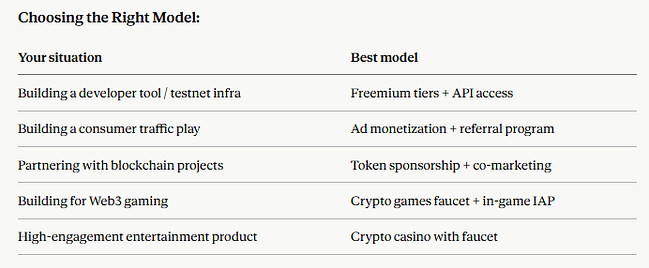
7. Marketing Strategies — How to Build Traffic for a Faucet Platform
Telegram → Create a channel for balance updates, new chain announcements, and community milestone posts. Crypto Telegram communities move fast. A well-run faucet Telegram group becomes a retention tool — users check in daily because they don’t want to miss announcements.
Twitter/X → Post weekly stats: total claims, total crypto distributed, treasury health. This builds credibility. Reply to every developer asking “where do I get testnet ETH for Sepolia” or “BNB testnet faucet free” — those are warm leads walking in the door.
Discord → Build a Discord server with a bot that announces successful large claims, daily drip reminders, and community leaderboards. Discord communities around faucet platforms are underrated retention tools.
Content Marketing → Write developer-focused content targeting search terms like “Sepolia faucet free”, “free ETH faucet”, “sol faucet”, “BNB testnet faucet free”. Every tutorial article is a long-term traffic asset. The search volume on these terms is high, the content bar is low, and the conversion rate (searcher → user) is excellent.
Partnerships → Partner with developer communities, Web3 bootcamps, blockchain foundations, and DeFi protocols building on the chains you support. A single partnership with a developer education platform can deliver thousands of qualified users who actually need testnet tokens.
Referral Programs → I can’t say this enough — referral mechanics are the highest-ROI distribution channel for faucet platforms. Every user who refers 10 friends becomes a de facto growth channel. Build the referral system into V1, not as an afterthought.
8. Want to Build a Crypto Faucet Platform? Here’s How We Help.
I’ve built this exact stack. If you want to skip the architecture mistakes and go straight to a working product, here’s what we can do:
→ Pre-Built Faucet Infrastructure — A fully modular faucet system with all seven protection layers already integrated: CAPTCHA, PoW, IP limits, cooldowns, identity scoring, outflow control, and monitoring dashboards.
→ Faster Deployment — Launch your own branded crypto faucet app in weeks, not months. Multi-chain support out of the box — Ethereum, Base, BNB Smart Chain, Polygon, Solana.
→ Full Customization — White-label the entire product. Add your token, your branding, your monetization model. We build, you own.
9. Conclusion
The crypto faucet is one of the oldest primitives in Web3 and one of the most misunderstood business opportunities. Built naively, it gets drained by bots in hours. Built with the right layered architecture, it becomes a durable traffic asset, a developer onboarding tool, and a monetizable platform at any scale. The technology is not the hard part, as the discipline to build the protection stack right from day one is.
Whether you’re launching a testnet faucet for your EVM chain, a consumer crypto gift platform, or a full crypto faucet app with games and referral mechanics, the window to build and capture search traffic is open right now. I’d be watching the sol faucet and Base faucet niches especially closely heading into the next cycle, both are underbuit and overdemanded.
Disclaimer: This is based on what I’ve seen building in Web3. Nothing here is financial advice. Do your own research before deploying or investing.
— Akash
Frequently Asked Questions
What is a crypto faucet?
A crypto faucet is a website or app that gives users small amounts of cryptocurrency for completing simple tasks or verification steps. In Web3, faucets are commonly used to distribute free crypto, either as testnet tokens for developers or tiny amounts of real cryptocurrency for onboarding and marketing purposes. Examples include Sepolia ETH faucets for developers and Bitcoin faucets for new users.
What is the difference between a testnet faucet and a mainnet faucet?
A testnet faucet distributes tokens that have no real monetary value and are used for testing applications on networks such as Ethereum Sepolia or BNB Testnet. A mainnet faucet distributes real cryptocurrency that has actual value. Because real funds are involved, mainnet faucets require stricter security and anti-abuse measures than testnet faucets.
How do crypto faucet sites make money?
Most crypto faucet sites generate revenue through advertising. Every user visit and claim session creates ad impressions that earn revenue. Additional income sources include premium memberships, affiliate partnerships with exchanges, referral programs, sponsored token campaigns, surveys, games, and promotional offers.
What is an auto faucet in crypto?
An auto faucet automatically sends small amounts of cryptocurrency to users at fixed intervals without requiring a manual claim every time. Users typically keep a browser tab open or run a lightweight application. These faucets improve user retention but require stronger protections against automated abuse.
Is it safe to use a free crypto faucet app?
Legitimate crypto faucet apps and websites are generally safe if they only require your wallet address. You should never share your seed phrase or private keys with any faucet. Avoid platforms that request excessive permissions, wallet approvals, personal information, or suspicious software downloads. Stick to reputable providers and official blockchain ecosystem tools.
What is the best faucet for Sepolia testnet ETH?
Popular Sepolia ETH faucet providers include Alchemy, Infura, QuickNode, and Google Cloud. These services typically require account verification or developer sign-in to prevent abuse and ensure tokens reach genuine developers.
Can I build a crypto faucet app without coding experience?
Building a production-ready crypto faucet usually requires basic full-stack development knowledge, including frontend development, backend APIs, databases, and wallet integrations. However, no-code and white-label solutions are available that can significantly reduce the technical barrier. Someone familiar with JavaScript and web development can often launch a simple faucet within a few weeks.
What is a faucet lottery token?
A faucet lottery token is a feature used by some faucet platforms where part of each claim contributes to a prize pool. Users receive lottery entries based on their activity or balance and have a chance to win larger rewards through periodic draws. This gamification strategy encourages repeat usage and long-term engagement.
How do I prevent bots from draining my crypto faucet?
The most effective approach is layered security. This includes CAPTCHA or Turnstile verification, rate limiting based on wallet addresses and IP addresses, cooldown periods between claims, proof-of-work challenges, and detailed logging of user activity. Combining multiple protection methods is far more effective than relying on a single defense mechanism.
What blockchain is best for running a crypto faucet?
For testnet faucets, the blockchain depends on where developers are building, with Ethereum Sepolia, Base, BNB Testnet, and Solana Devnet being common choices. For real-value faucets, low-fee networks such as Base, Polygon, and BNB Smart Chain are preferred because transaction costs remain low. Solana is also popular due to its extremely low fees.
Are there high-paying crypto faucets that are legit?
Legitimate high-paying faucets are uncommon. Most reputable faucets provide only small rewards because larger payouts are difficult to sustain. The best opportunities usually come from blockchain foundations, developer ecosystems, testnet campaigns, or token launch promotions where projects have dedicated budgets to encourage adoption and network activity. Be cautious of any faucet promising unusually large or guaranteed returns.
Need a custom Web3 platform for your project?
We design, build and deploy custom audited staking portals, claim utilities, prediction markets, and crypto casinos tailored to your branding. Fully operational in 2–4 weeks.


